
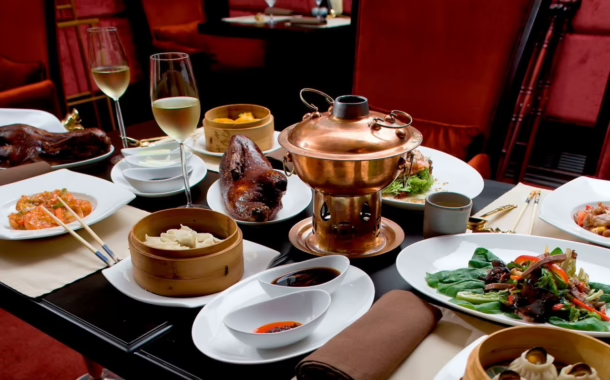
How much time should you factor in for a meal for 10 guests? How much should you eat and drink? Get clued in about the complex world of Chinese banquet dining

From weddings to birthdays and even to welcome a foreign friend, any reason, however small, is enough for Chinese hosts to throw a feast. Grand celebrations of food and community, Chinese banquets are wholly fascinating, yet also tricky to navigate, thanks to unique customs and dining etiquette that are steeped in symbolism.
“Dinner is very much ingrained in the Chinese culture of socialising and business talk,” says Jason Chow, a cultural integration lecturer who spent six years working in central China. The nuances of dining in various countries can also make a significant difference in etiquette. Here, the seasoned banquet diner shares his top tips on fitting in and dining like a pro.
1. Clear your schedule
Chinese banquet meals are known to be notoriously long. Meals in cities like Singapore and Hong Kong often feature eight courses (eight symbolises wealth), which take at least two hours. In China and sometimes Taiwan, a banquet can often be an elaborate ensemble of 20 dishes, so factor in four to five hours for that. It is also considered rude to leave earlier. If you make up an excuse, don’t be surprised if your host requests that you run that errand and then return to dinner.
2. Be prepared to wait
Hosts in fast-paced cities are moving towards starting banquets, especially wedding celebrations, on time. However, you can still expect to wait, more so if it’s a business occasion. You may be asked to arrive an hour or more before the most important guest. If the meal is hosted in a private dining room, it will often have a sofa on which you can wait while watching television and sipping hot tea. Similarly, wait to be seated at the table, and do not begin eating until the host has served the first portion to you.
3. Make small talk
At social and business meals in China, it is common practice for hosts to invite their friends, colleagues, family and other notable members of society to “fill up” spaces at the table. Banquet meals are never small affairs, as it is considered rude to let hosted guests eat alone. Thus, do be prepared to engage in casual conversation with strangers.
4. Serving culture
Most banquet tables will be set up with individual bowls and plates. Never put the food you wish to eat on your plate – it should go into your bowl. The plates are meant to hold unwanted food bits, like bones. Banquets are often served communal dining style, accompanied by serving cutlery, which guests should use to serve themselves. Should that not be provided, turn your individual chopsticks around and use the tail end to take food from the communal plate.
5. To waste or not to waste
In most Chinese cultures, it is reassuring to have leftover food as a sign that guests are truly full. This is especially so in China, where an abundance of leftovers is reflective of the host’s prestige and wealth. If you are served something that you do not eat, it is good form to taste it, and then show your appreciation for the dish.
6. Bottoms up
Alcohol is enjoyed in excess at banquets, and the drink of choice is often Chinese liquor. The host would propose a toast to the group at the start of the meal, and then proceed to toast every guest at the table, starting with the VIP. Guests are then expected to propose individual toasts. It is a sign of humility to make sure the rim of your glass is slightly lower than the person with whom you are chinking glasses with. To keep your drinking in check, observe how much the person toasting you drinks, and do likewise.
Commonly used Chinese terms at banquets
Zhen hao chi: Say this enthusiastically throughout the meal to compliment the food.
Wo jing ni yi bei: This is commonly used to propose a toast.
Zhu ni shen ti jian kang: A toast often comes with an idiom or well wishes. This is the most basic phrase wishing good health to the person you are toasting.
Guo jiang le: When praised, don’t say thank you (xie xie) as it means you are accepting the compliment, which can be regarded as slightly obnoxious. It is more humble to instead say, “guo jiang le” which means that what is being said is too extravagant.
Xin ku ni le: At business banquets, this is a good way to acknowledge the hard work teammates or colleagues have put in.
– TEXT BY ANGELEIGH KHOO
PHOTO: 123RF.COM
This article was originally published by Singapore Press Holdings.