
Published on April 30, 2026
Soul of Sydney
In this journey through three neighbourhoods – Redfern, Marrickville and Pyrmont – we uncover the histories that helped define the city today, from Aboriginal life to migrant food cultures and the reinvention of a working harbour
Redfern: Where aboriginal culture lives on in art
Morning begins in Redfern. The autumn sun has barely risen when we step out of Redfern Station and walk five minutes north. We’re in an inner southern suburb just minutes from Sydney’s CBD and long considered the heart of the city’s urban Aboriginal community.
On Hugo Street, colour bursts across a terrace once part of the housing area known as “The Block”, purchased in the 1970s to create one of Australia’s first urban Aboriginal housing communities.
Red, black and yellow stripes run down the façade. A lone canoe cuts through them. Welcome to Redfern, painted in 2013 – by Reko Rennie of Kamilaroi/Gamilaraay/Gummaroi heritage and other young Aboriginal artists – feels less like a mural than a declaration: memory lives here.
Across the road, the Redfern Community Centre carries the story forward. Its mural folds sky, land and water together – serpents, children and Aboriginal flags moving through the scene.
Dhungatti artist Blak Douglas painted it in 2006, when the terraces of The Block – once home to generations of Aboriginal families before they were demolished in 2015 – still stood nearby.


“I traced the torsos of local kids to leave a visual imprint – a memorial,” he says. “Male spirits appear as Cadi, the grass as trees; female spirits as Warradah, the waratah (an Australian native flower).”
Redfern’s history is painted on its walls, but it is built into the ground as well. Fifteen minutes to the southeast, an imposing brick-and-steel structure rises into view. Here stands Carriageworks, a former railway workshop now transformed into one of Sydney’s leading contemporary arts centres.
Today it is one of Australia’s busiest creative precincts and home to a popular Saturday farmers’ market. A century ago, however, it was a place of industrial labour. As the former Eveleigh Railway Workshops, it drew families from across New South Wales, shaping one of the country’s earliest urban Aboriginal communities.
By the 1970s, Redfern had become the centre of the modern First Nations civil rights movement. The Block, established in 1973, served as both refuge and meeting place of organisers and advocates.
“The Block is a changed place and no longer has the capacity for grassroots [activities],” Douglas says.
He recalls the movement led by Aunty Jenny Munro, a respected Aboriginal advocate who, in 2014, set up camp on The Block to stop the land from being sold or redeveloped.

After sustained pressure, Munro secured an agreement to protect First Nations interests, driven by a fear of gentrification – that land would be sold off and Aboriginal people would move out of the neighbourhood they had long called home.
What followed was a period of loss, but also determination. The community found another way to hold its ground. Art became the vehicle for renewal, a means of asserting presence, memory and identity in a rapidly changing suburb.
Douglas was central to that shift. A prominent figure in both the community and the art world, he lived in Redfern from 2006 to 2022.
“The advantage of being but a boomerang’s throw from art galleries, both institutional and commercial, was a necessity as an emerging artist,” he says.
We pause at the meeting circle he created outside his studio, on the corner of Redfern and Renwick Streets. The surrounding wall now carries a vibrant nature mural by Aboriginal artist Uncle Danny Eastwood and his son, James.
Over time, gentrification changed the suburb. Studios closed. Rents rose. Many artists moved on. While some Aboriginal people remained, Douglas says the area began to feel like a sanitised version of itself, rather than the real thing.
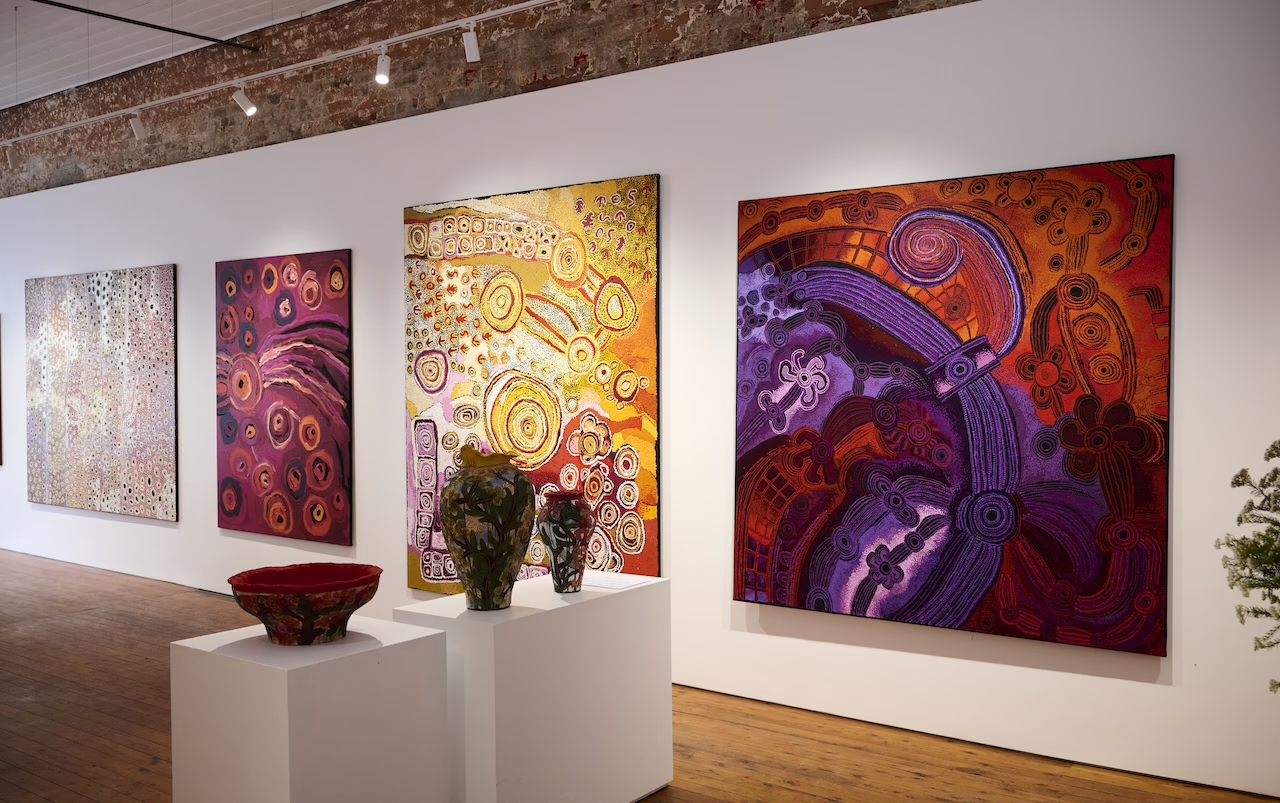
“Redfern continues to hold a deep reverence as the epicentre of Koori culture.”
Today, Redfern Street hums with cafés, bars and shops set among 19th-century terraces. Douglas has since left the neighbourhood, though he notes that the council is now taking steps to better support artists and the Aboriginal community to return.
The APY Gallery, a First Nations-owned gallery and training space that opened on Redfern Street in November 2025, is an important part of that resurgence. Exhibitions and works often centre on family, celebrating communities working together across generations and Country.
The Redfern Community Centre is another place where community ties are kept strong. It works with First Nations organisations to run workshops and courses focused on music, connection, food and support for business and employment.
“The Redfern Community Centre is worth visiting, if only for nostalgia,” Douglas says. “Redfern continues to hold a deep reverence as the epicentre of Koori culture.”
These days, he explains, the heart of community life is the Aboriginal Medical Service on Redfern Street. We pass its solid red brick façade, glowing in the morning light, the flag flying high above.
“A walk down Little Eveleigh Street to Carriageworks never disappoints,” Douglas adds. “And Redfern Park will always have a place in my heart, a pocket of calm amid the density of the city.”
Marrickville: Where global kitchens reshaped Sydney’s food culture
Across the city, Marrickville tells a different story. In Sydney’s inner west, this is a place built through migration, where reinvention has unfolded over generations.
Stepping onto Illawarra Road in the late morning, it’s immediately clear why the strip is known as “Little Vietnam”. After the Vietnam War, Vietnamese migrants made Marrickville home, bringing with them food, language and shared rituals.
Grocers, bakeries and family run eateries followed, stitching daily life together through aroma and flavour. Much has changed since, but Marrickville remains vital to over 90,000 residents born in Vietnam who call Sydney home.
The air is thick with smells, sounds and sights. Bright Vietnamese basil, coriander and lemongrass hit the nostrils. Pots knock together in narrow kitchens. Neon signs glow in two languages: English and Vietnamese.
A mural of a kangaroo beside blooming lotuses – Australia’s fauna next to Vietnam’s national flower – captures the harmony of cultures here in one frame.

“Marrickville is one of Sydney’s most multicultural suburbs, and Vietnamese culture plays a significant role in shaping its identity today,” says Cuong Nguyen, owner of modern Southeast Asian restaurant Hello Auntie on Illawarra Road.
Nguyen opened Hello Auntie in 2015, but his ties to the neighbourhood run much deeper. The 46-year-old chef arrived as a child with his family from Can Tho in southern Vietnam and has lived nearby since 1996.
After years working in hospitality, he noticed a change. Contemporary, city-style venues were emerging beyond the CBD, and Marrickville stood out. Its strong food culture and diverse, inquisitive community made it ripe for reinvention.
As long-time residents moved on, young families and middle-aged city dwellers arrived, drawn by bold, fusion flavours.
As Nguyen prepares for lunch service, the menu distils these changes onto the plate. Steak is grilled over charcoal, finished with Vietnamese coffee butter and a pho “mother sauce” a year in the making. Carbonara is reworked with century egg, lap cheong (dried Chinese sausage), pecorino, ginger and Sichuan pepper.
“I grew up eating Vietnamese‑Australian food,” Nguyen says. “My mum mixed Western and Asian ingredients. Cooking between cultures is natural to me.”


“Marrickville is one of Sydney’s most multicultural suburbs, and Vietnamese culture plays a significant role in shaping its identity today.”
“We sometimes receive criticism for not being strictly traditional, but the food is authentic to my experience,” he continues.
Nguyen’s cooking reflects how many Vietnamese families in Australia actually eat at home. For Nguyen, those flavours and combinations are traditional in their own way, grounded in his upbringing and the lived experience of the Vietnamese diaspora in Australia.
“Tradition doesn’t stand still. It evolves with the people who carry it,” he adds.
By midday, Illawarra Road hums. Office workers and locals line up for bánh mì from Illawarra Pork Roll, a tiny shop turned local institution. Others linger over sweet Vietnamese coffee at Café Nho or slide into booths at Hello Auntie for a longer lunch.
Beyond Vietnamese cuisine, the neighbourhood opens out into a world of flavours: Greek, Filipino, Peruvian. Boutique distilleries and craft breweries sit alongside hip bars and cafés, many run by a new generation of hospitality talent.
Pyrmont: From working harbour to waterfront revival
It’s afternoon by the time we reach Pyrmont, the inner-city peninsula west of the CBD. The sun drops into a warm, honey-coloured angle, washing the neighbourhood in soft light.
Pyrmont is a place where Sydney’s harbour story unfolds in layers – from Aboriginal fishing grounds to the industrial engine of the working harbour and to today, one of the city’s most visible waterfront renewals.
Long before wharves and shipyards crowded the shoreline, these waters formed part of the harbour country of the Gadigal people of the Eora Nation, who fished, gathered shellfish and travelled across the bay by canoe.
By the late 19th century, Pyrmont had become a key hub of Sydney’s working harbour, its waterfront lined with wharves, shipyards and factories that powered the city’s maritime trade.
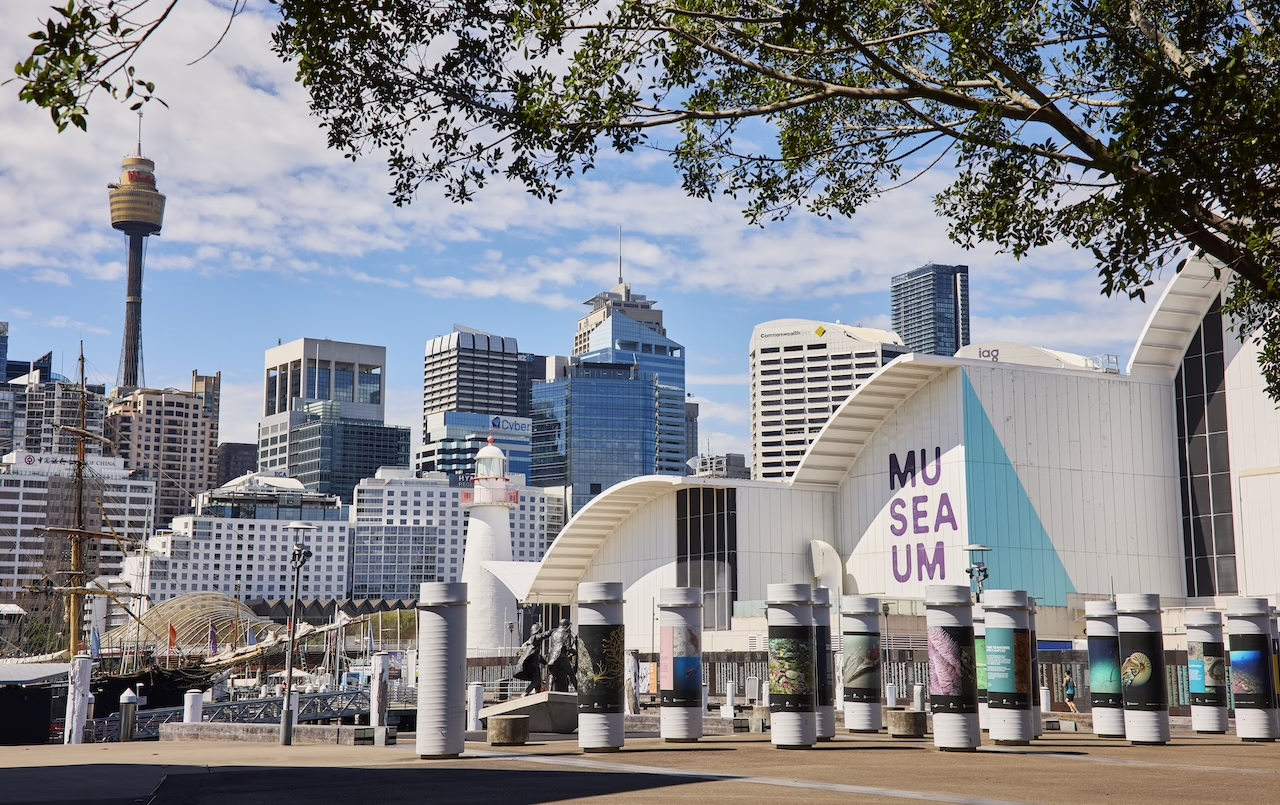
Even today, with major redevelopment under way following the 2023 Western Harbour announcement, traces of that past remain easy to see. One place where that history comes alive is the Australian National Maritime Museum, rising on the waterfront like a cluster of sails.
Its setting is deliberate. Standing on Darling Harbour, the museum sits within what deputy director Michael Baldwin describes as a “living harbour”, shaped by Aboriginal life, labour, relocation and global trade over centuries.
Inside, vast galleries trace the many strands of Sydney’s maritime story. In the Sydney Harbour Gallery, it becomes clear how much the city has grown around the waterway.
Rather than standing apart from Pyrmont’s industrial past, Baldwin says, the museum is “firmly rooted within it”, telling a story of work, movement and connection.
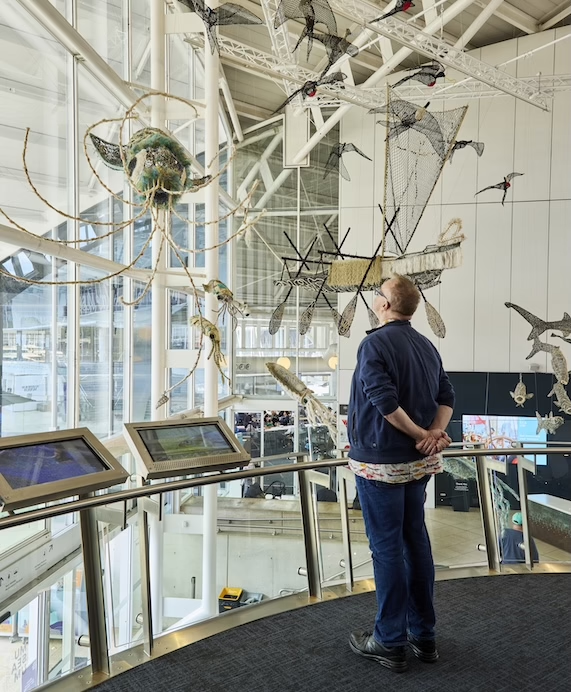
“The museum is a keeper of the harbour’s everyday past – its boats, its tools, its lives,” Baldwin adds. “And through the ‘National Monument to Migration’ exhibit, it honours the people who came to Australia by sea, then by air, with new names added each year.”
Outside, timber piers stretch into the harbour, echoing the area’s working past. Fishing boats, commercial vessels and naval ships sit moored side by side. Visitors move between them, stepping aboard everything from small craft to major ships, including a replica of Captain Cook’s vessel Endeavour.
We climb onto HMAS Vampire, Australia’s largest surviving fleet destroyer, which served from 1959 to 1986 and offers a glimpse into the country’s Cold War naval history.
About 20 minutes west, the Sydney Fish Market continues Sydney’s harbour story. Established in 872 and reopened earlier this year, the revamped AU$836-million building houses seafood wholesalers, retailers, restaurants and cafés. Its roof curves like waves and fish scales, fronted by a wide promenade along the water.
All this redevelopment has transformed Pyrmont. Once quieter, it is now dense with apartments, offices and commercial spaces.
Construction temporarily reduced casual visits to the museum, Baldwin tells us, but it also widened its reach. Urban renewal, he says, has pushed the museum to evolve alongside the suburb, engaging workers, locals and commuters whose lives now unfold along the waterfront.

“Pyrmont’s position within Australia’s oldest and largest port city cements its role as a cultural anchor, a place where Australia’s relationship with the sea is not just observed but lived."
By late afternoon, his point becomes clear. We slurp oysters at the fish market as it hums into early evening, locals streaming through with seafood for a barbecue. Nearby, people linger at Pirrama Park for a yarn by the water, while office workers drift into Pyrmont bars for knock off drinks.
Along the harbour’s edge, everyday life unfolds, just as it always has. Baldwin says, “Pyrmont’s position within Australia’s oldest and largest port city cements its role as a cultural anchor, a place where Australia’s relationship with the sea is not just observed but lived.”
As Sydney continues to evolve, places like Pyrmont suggest what lies ahead – a city shaped not only by renewal, but by how its histories are carried forward into everyday life.
Along the harbour’s edge, past and future remain in constant dialogue, quietly redefining what Sydney is becoming.
For more information on Singapore Airlines’ flights to Sydney, visit singaporeair.com.