Battling overdevelopment and climate change, environmental advocates in Semarang are working together to restore vanishing mangrove forests

As a sultry breeze blows in from the Java Sea, the retreating sun bathes a brackish pond in a tangerine glow. Along its border, a rounded boardwalk – illuminated by wooden lamp posts made from repurposed cattle plows – hugs a thick cluster of mangroves crowned with waxy, deep-green leaves and buttressed by stilted roots. A teenage couple sits at the edge of the elevated pathway, their sandaled feet dangling just above the water. On the pond, a group of four young women in black hijabs laugh loudly while trying to manoeuvre a bright-red pedal boat.
Recent years have seen the well-received emergence of mangrove parks in Semarang, the provincial capital of Central Java. Grand Maerakaca, just east of the new airport terminal, draws the most tourists, thanks to its coastal reforestation projects. Established in 1991, the 23ha government-owned cultural park features scaled-down replicas of landmarks from the province’s 35 cities and regencies. In 2015, as part of efforts to revitalise the run-down attraction, a 450m boardwalk was built around mangrove trees planted several years earlier. The photogenic addition, which represents the Karimunjawa Islands on the Java Sea, became an instant hit on social media.

“I never imagined it would be this popular!” exclaims 53-year-old park director Titah Listiorini, who largely credits the mangrove boardwalk for the huge leap in the number of visitors from 25,000 to 452,000 people every year. “We first planted mangroves to beautify the park, only to realise later that they serve important functions too,” she adds, lighting up with enthusiasm. “We will be replanting another three-hectare pond soon.”
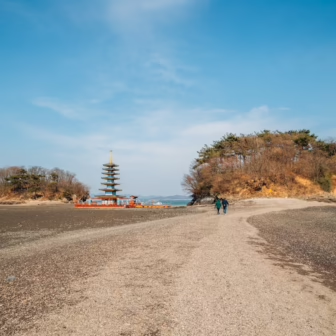
On the other side of the airport, however, things aren’t so pretty. “The beach used to be over there,” 36-year-old farmer Sutopo recalls, pointing at a cluster of fence-like bamboo fish traps, around 100m from the present waterline of Pulau Tirang. Over the decades, the kilometre-long islet off the coast of Tapak village has shrunk into a narrow strip of ash grey sand.

For coastal residents like Sutopo, the dangers of global warming are ever present. Along the northern coast of Java – home to more than half of Indonesia’s population of 270 million – abnormal tides are swamping seaside settlements, and pushing the shoreline several hundred metres further inland
Like other coastal cities across the world, Semarang is severely affected by rising seas caused by thermal expansion – water expanding due to higher temperatures – and the melting of polar ice resulting from climate change. In addition, the oceans surrounding the world’s largest archipelago are rising at a faster rate than elsewhere on the planet. A comparative analysis of satellite images from 1993 to 2015 revealed that sea levels in Indonesia were rising 5.8 mm per year versus a global average of 3.8 mm. To make matters worse, large areas of Semarang, a major port city of two million people, are rapidly sinking as a result of overbuilding and groundwater extraction – an issue faced by many Southeast Asian cities.
“Hopefully, more young people like us will care about coastal ecosystems”
Fortunately, more people in Semarang are understanding the importance of restoring mangrove forests, a natural means of mitigating coastal erosion and flooding, while serving as essential breeding grounds for all sorts of marine life. While 90% of the city’s mangroves have been cleared for farming and land reclamation, the last decade has seen enlightened stakeholders team up to reverse that trend. “We need to fight together for the mangroves,” Sutopo says.

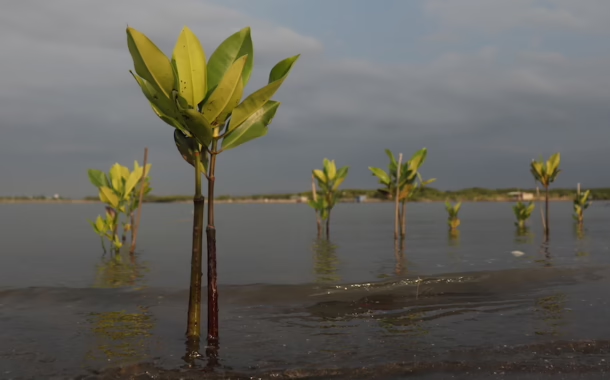
At Tapak, where 100ha of mangroves have been cleared for an industrial estate, Sutopo and other farmers founded a pokdarwis (an Indonesian portmanteau for “tourism awareness group”) to protect the remaining 300ha of forest in their village from unsustainable development and prevent further coastal degradation. They do this by planting more mangrove trees and constructing temporary breakwaters out of recycled tyres.
With the current city administration prioritising tourism, the local government also sees mangrove conservation sites as viable ecotourism attractions, with plans to improve access roads and build better facilities. But according to Indriyasari, head of the Semarang City Culture & Tourism Office, “We [the government] cannot do it on our own. Everyone needs to participate in mangrove conservation, especially the communities along the coast.” The 46-year-old official points to the collaborative work of academic institutions and private companies engaged in corporate social responsibility (CSR) programmes as examples of how this can work.
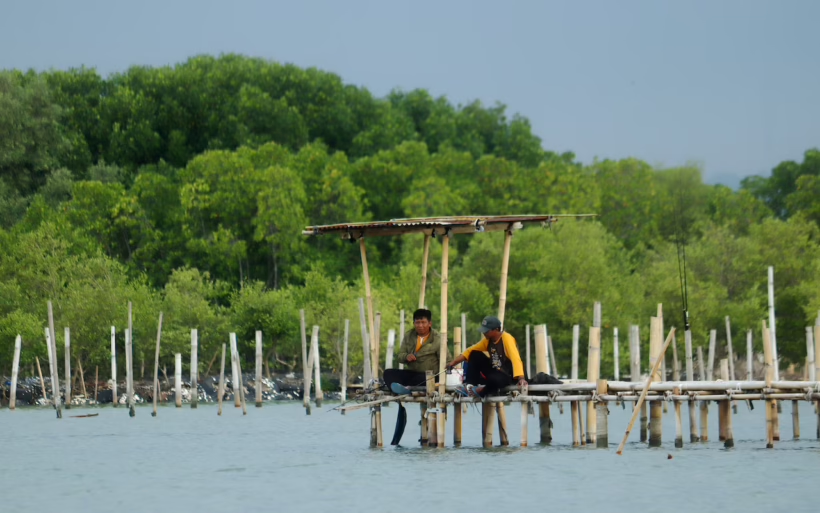
In 2015, Tapak village launched guided tours that take visitors on perahu sopek (traditional boats) through mangrove-shaded canals to Pulau Tirang, where they can plant seedlings along the shore to prevent further erosion. Meanwhile, Phapros, a pharmaceutical firm that operates a local factory, mobilised farmers at nearby Maroon Beach to replant two hectares of mangroves in 2011, which has been turned into a community-run “edu park”, catering mostly to student field trips.

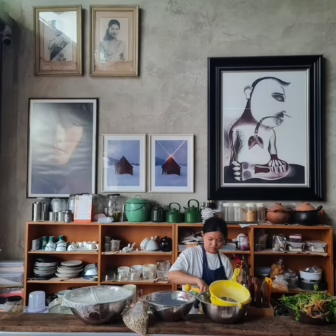
Interestingly, even local artisans have joined the cause, incorporating mangrove conservation with a handicraft that’s deeply rooted in Javanese culture. Marheno Jayanto – a Jakarta-born batik master who helped to revive Semarang’s batik industry in 2007 – pioneered the use of brown dye extracted from the fruit of the bakau or red mangrove. This is a sustainable alternative to harvesting its bark for colouring, which necessitates cutting down the trees. “I started by collecting mangrove propagules that washed ashore, but now buy them from coastal communities in Semarang,” the affable 48-year-old craftsman explains at Zie Batik, a workshop he runs at home with his wife in Malon village, 16km south of the city centre. “By utilising mangrove propagules as batik dye, we can teach communities the importance of protecting mangrove forests.”
One of the groups he has trained to make batik bakau is Mangunharjo, a coastal village of 8,500 people, 18 km west of the city centre, whose shrimp farming industry – which stripped away nearly all of its mangroves – collapsed due to tidal flooding that began in the late 1990s. The community learnt its lesson the hard way and is now finding more sustainable forms of income.

Besides handcrafting batik bakau, the women villagers have also developed traditional snacks and desserts made with flour processed from the fruit of the black mangrove, locally known as lindur. While boiled lindur fruits with sugar and grated coconut have long been enjoyed as a snack, processing them into flour is a relatively new innovation introduced seven years ago with help from Jakarta-based company Indonesia Power and KeSEMaT, a mangrove conservation organisation founded by marine science students of Diponegoro University in 2001.
Bifa Manuhuwa, former president of KeSEMaT, worked closely with the Mangunharjo community over the past three years. Aside from facilitating sustainable mangrove-based livelihoods, the 200-member conservation group also conducts regular reforestation activities, planting 1,000 to 2,000 seedlings every year in the village. “Hopefully, more young people like us will care about coastal ecosystems, especially mangrove forests that serve many important functions,” the 21-year-old Bifa says, wearing a shirt that reads Mangrove For People. “We cannot survive without mangroves.”

With concerned citizens from different walks of life supporting the movement, mangrove forests have the potential to flourish again along Semarang and the rest of the archipelago, saving millions of lives and turning the tide for the entire planet.
SilkAir flies four times a week between Singapore and Semerang. To book a flight, visit singaporeair.com
SEE ALSO: 6 tips for visiting Borobudur in Indonesia
This article was originally published in the July 2019 issue of Silkwinds magazine