
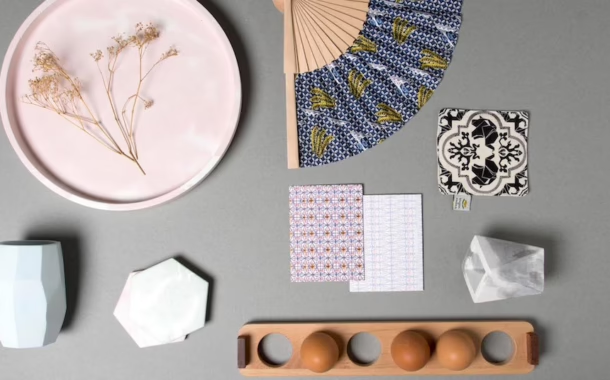
A growing army of local creatives is fashioning a new design scene in Malaysia's capital city
When it comes to the design scene in Southeast Asia, Malaysia has long stood in the shadows of neighbours Singapore and Thailand. Indeed, until very recently, a made-in-Malaysia product usually meant some hand-beaten pewter, mengkuang (pandanus) handicraft or block-printed batik textile – all beautifully crafted, but also invariably traditional.
That’s all beginning to change. Today, Kuala Lumpur is home to a growing number of creatives, who are slowly but surely forging a brand new Malaysian design vocabulary that brings the modern to the classical.
Starting small
Malaysia owes its emergence as a design hub in part to hobbyists-turned-entrepreneurs. For Adesh Zaini and Shahfiq Manap, the husband-and-wife team behind BentukBentuk (“shapes” in Malay), what began as a DIY project to make a concrete planter has blossomed into a thriving business. Today, the duo dreams up useful products made from local concrete, such as ring holders, card racks and platters. While neither has a design background and both still work full-time jobs outside the industry, their passion is apparent. “It requires a clear mind and effort to design a new collection, but we are determined to use whatever time we have to progress,” Adesh says. “Our idol is Royal Selangor, and we hope that one day, Malaysians will feel just as proud to gift BentukBentuk products to their foreign friends.”
Even smaller are operations like Thirty3Eleven, a ceramics line that harnesses clay mined in nearby Johor and is glazed using local minerals. The line is singlehandedly run by Ee Vee Lee, who took up pottery classes just two years ago and does all the production herself. “I occasionally get help from my husband when things get too heavy to lift,” she says with a smile.
“I see ceramics as art. Like a painter who can’t outsource his brushwork to another hand, the designer and maker are one.”
Connecting past and present
While adopting a decidedly modern outlook, KL’s contemporary design outfits have not forgotten their roots. Another homegrown brand, Bingka (named after the popular local snack of steamed tapioca cake) creates its own handprinted textiles using silkscreen methods with predominantly Malaysian materials like unbleached cotton and canvas. Founded by friends Adrihana Abdul Rashid and Emmalynn Yam, its motifs celebrate iconic Malay foods such as kuih (colourful bite-sized snacks), popular drinks like teh C peng (iced tea with condensed milk), vernacular architecture and tropical flora and fauna. These are then printed on pouches, tote bags and soft home furnishings like throw pillows, coasters and tea towels.
“The Bingka aesthetic focuses on producing quirky designs that resonate with the Malaysian soul,” Adrihana says. “They tend to have a more vintage feel, but with a fresh twist.” Similarly, Dutchwoman Lisette Scheers is unabashed about how her childhood growing up in Malaysia inspired her successful label, Nala Designs. In 2012, she started out making notebooks and ang bao (red envelopes for gifts), but now produces a full- fledged range of apparel, accessories and homeware.
Dubbed by the local press as the queen of patterns, the trained graphic designer finds inspiration in all things local, from retro window grilles to intricate Peranakan porcelain. Recently, she opened a concept store called Nala Kampung House in a beautifully preserved wooden house located in the trendy Bangsar neighbourhood.
This preoccupation with Malaysian elements at modern design firms has an important impact – generating new job opportunities for traditional craftsmen and artisans. A case in point is MAD3 Studio, a collective comprising Tang Mun Kian, Desmond + Phang and Bernard Chong, who first met while working at an advertising agency.
Working with local artisans, MAD3 creates chairs and stools using steel and woven PVC cords, which recall the ubiquitous seats found in many Malaysian homes in the 1960s. “Our chairs are inspired by simple lines, patterns, shapes, colour combinations and weaving methods,” enthuses Chong. “We focus on traditional techniques with a contemporary spin.”
The collective is now taking this approach further by using woven rattan for loungers and stools, in the hope of reinvigorating the vanishing cane furniture trade.
Other designers collaborating with traditional craftsmen include Wei Ming Tan of Aureole Design, which produces a small but considered range of lighting embodying an elegance of form. Tan, whose passion for industrial design led her onto this path, makes the prototypes, but enlists local manufacturers to bring her designs to life. She uses local materials like Malaysian clay and stone to construct the lamps’ ceramic and terrazzo bases.
Then there’s MUKK, which was founded by industrial designers Vivian Lam Shi Wei and Chia Yi Sim. At their practice, Super Struxture Studio, they design lifestyle gifts, furniture and stationery made from Malaysian plantation wood, such as the Lunahills coaster, which doubles up as table décor.
“We partner with Malaysian craftsmen, artisans and designers because we want to champion and evolve this field,” explains Sim. “We can proudly say that we are 100% designed and made in Malaysia.”
Fuelling the growth
For any industry to flourish, there needs to be a market for its products. While these designers actively use social media, websites and online marketplaces to market their creations, there is also a growing number of independent stores around the Klang Valley (or Greater Kuala Lumpur) who stock their wares. Additionally, weekend markets and craft bazaars provide more platforms for makers to sell their products.
“Many current home buyers are young people, which has changed the dynamics of the design industry,” says Adesh. She also believes that more design-savvy media outlets and hip coffee joints have helped expand the concept of good design among consumers.
But even as supply and demand for modern Malaysian design finds a natural equilibrium, the designers agree there is still a lack of government support; additionally, finding suppliers is still a challenge.
Despite these obstacles, the industry continues to flourish. “Makers are more visible now, and there are more platforms available to showcase our products and services,” says Adrihana. Indeed, the future of Malaysian design certainly looks bright.
Where to browse for a piece of modern Malaysian design
This bright and airy store is filled with lush greenery and lifestyle-, fashion- and design-centric objects from local labels such as
Aureole Design.
A concept store and premium tea café offering international and local design products like BentukBentuk’s edgy yet elegant home décor. pieces.
KL’s coolest place to buy locally crafted furniture and home accessories from STUDIO BIKIN, Thirty3Eleven and many others.
SEE ALSO: The people behind Dubai’s evolving design scene
This article was originally published in the January 2018 issue of Silkwinds magazine