
Ahead of the 2022 Winter Olympics, China’s ski industry is soaring, from the flourishing ski villages around Shanghai and Beijing to the dramatic, wild mountains bordering Siberia
Are we still in China?
As my skis slide through sunlit granules of cold, fresh powder, I wonder if we’ve now left the Middle Kingdom. Locals told us that a picket fence would be the obvious border marker, but that fence is now buried under nearly three metres of dry snow. Breathing clouds of vapour into the icy afternoon air, our trio gingerly traverses an arm of the mighty Changbai Mountain, the shimmering volcanic crater lake that forms the natural land limit between the remote northeast of China and North Korea. In addition to its geographical significance and striking panoramas, Changbai Mountain is also a national park for two separate nations and the site of China’s first cat-skiing (involving guided, backcountry exploration) operation: Changbaishan Powder Paradise.

It is the latter that brings us to the edge of nowhere, a frozen orographic blip that steals snow from storms spinning down from Siberia on their way to Japan. In the last decade, China has gone from having six ski resorts to over 700 – a higher tally than all of Europe combined – in an unprecedented boom that has expanded recreational skiing from urban centres such as Beijing to the old Silk Road, the foot of the Chinese Himalayas and even here, to the wild, far-flung border with North Korea.
With China’s slopes seeing 17.5 million skier visits in 2017 alone (according to the China Ski Industry White Book, an annual report by Beijing-based ski industry consultants), some experts predict it won’t be long until the masses turn this place into a bustling mountain playground akin to the ski areas surrounding Beijing. Though 1.2 million Chinese skiers took their skis abroad in that same time, untouched forests and alpine bowls like those of Changbai Mountain and the wild peaks of western China could be the draw for an aggressive ski market already craving the next big thing. In fact, just a two-hour flight from the nation’s capital, Changbai Mountain and neighbouring resorts have already prepared for the inevitable, constructing and opening the area’s first airport to handle an influx of winter and summer tourists alike.

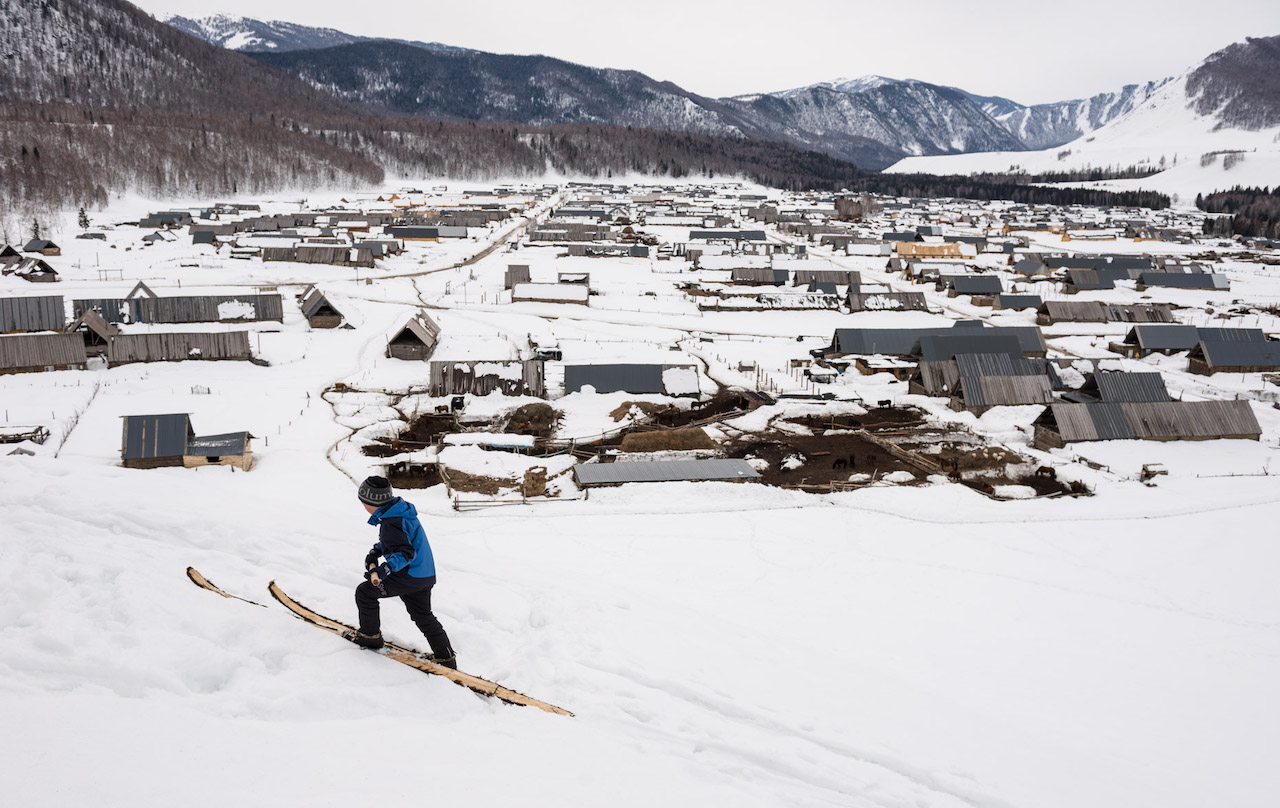
Today, however, the ridgeline sits blissfully empty. Clicking our poles, we turn our backs on border fences and any potential political mishaps, flying through a forest of perfectly spaced birch trees. Like ribbons unfurling, our snaking powder turns curl towards the waiting snowcat below. “I don’t think this is a fad,” explains Justin Downes, a 48-year-old China ski expert and president of Axis Leisure, a Beijing-based resort management company. “The large number of [China-based] skier visits is still a low percentage of the total population. This is a new market, so that penetration is just going to rise.”China’s ski roots trace back over 10,000 years, when nomadic hunters first used two hand-carved spruce planks to head out on hunting expeditions in search of deer, ibex and rabbit in western China’s untamed yet exquisite Altay region.
"Like ribbons unfurling, our snaking powder turns curl towards the waiting snowcat below"
This fascinating history is considered one of the sport’s oldest, but skiing – and the market Downes describes – didn’t really take root in China until the early 2010s when President Xi Jinping, seeking his country’s first successful bid to host the Winter Olympics, famously promised the world 300 million Chinese winter sports participants by the opening of the 2022 Games. The decree worked, not only to secure Beijing as the host city, but to kick-start a ski industry that was still in its infancy. Nearly overnight, skiing became part of school curricula and ski infrastructure – resorts, hotels, roads and airports such as the one next to Changbai Mountain – began sprouting nationwide.

But skiing’s rapid rise has also achieved something else. In a country just emerging from decades of communist rule and rooted in the confines of filial piety, skiing, along with individual sports like yoga and trail running, has encouraged Chinese people to focus on their own health and well-being. While the price of entry remains high and ski education still lags behind that of Japan, North America and Europe, it is an emphasis on self-care that is giving a rising generation of Chinese citizens an active identity that could shape daily life for decades to come. “[Skiing] gets people moving, gets them outside and provides a life balance, and tourism and sport are two very big engines for that,” says Downes. “You can see it noticeably changing the way people live.”
Xiouyuan Wang is just one of these Chinese ski converts. Known throughout his ski community as Uncle Cho, he discovered skiing in his late twenties and decided to give up a steady corporate job at the age of 30 to rebuild his life around sliding downhill. Since then, the wiry free-skier has worked his way up the ranks of China’s fast-paced ski food chain, working as an interpreter for foreign ski instructors, starting a ski media company, opening a chain of 12 ski retail stores and even leading his own Chinese ski consulting firm, x2Rider.

Cho’s trajectory is a break from tradition. In a country that has long exalted the Confucian concept of family over everything, the 41-year-old is unmarried, doesn’t have children and rarely stays in his Beijing apartment. Instead, he says he has found fulfilment with a new community and a new outlook. He is the first in his family to ski, and while on the surface he appears calm and soft-spoken, his speech quickens and his eyes light up at the first mention of free-skiing, a daring discipline involving jumps, tricks and ample athletic creativity. “I don’t want to work every day in an office,” explains Cho. “I want to do something different.”
Indeed, Cho’s personal journey could not have come at a better time. Seeking to reach the lofty goal of winter sports participants set forth by their president, Chinese investors and the government itself have aligned with ambitious and entrepreneurial thinkers such as Cho and Downes. In 2015, Cho’s Huaxue Zhushou website, designed to provide users with ski information, videos and an online gear transaction platform, earned nearly US$2 million in angel investments before its public launch.

Downes, who developed vast resorts in British Columbia and Australia before landing in China in 2006, has helped complete some of the biggest resort projects in mainland China over the last decade, including the 80,000m2 Harbin Wanda Indoor Ski and Winter Sports Resort, the world’s largest indoor ski facility – though it will be eclipsed by a 90,000m2 ski centre near Shanghai in 2022. He says that the government not only supports this kind of development, but encourages it, offering developers tax incentives and the appropriate building permits if they include a snow sports facility as part of a shopping mall project or housing development, for example.
The push for grandiose new ski infrastructure is also in overdrive, and nowhere is that more obvious than the Beijing satellite of Chongli. Pegged to host the lion’s share of the ski events during the 2022 Games, the former potato-farming district in Hebei Province now features seven ski resorts and will add an eighth next season. Though it is currently connected to the nation’s capital via a dusty three-and-a-half-hour drive, a massive high- way project is slated to cut an hour o that time in the next few years. Next season, a train will connect Beijing skiers to the slopes in some 50 minutes.

Pastoral farms have now been replaced by high-rise hotels and international restaurants, while empty hillsides have transformed into fantastical mazes of gondolas, snaking ski runs and flashy mid-mountain lodges. Thaiwoo, the Western-style resort set to host the cross-country and ski jumping competitions in 2022, is bordered by the ageing remains of China’s Great Wall. Genting Resort Secret Garden, future host of the Olympic free-ski and snowboard slopestyle and halfpipe competitions, features a gigantic 10,000-room base hotel and rows of condominiums lining the pistes.
In total, the area receives less than a centimetre of precipitation in December and January, but resorts have chartered an unprecedented conglomerate of snowmaking pipes and guns to cover their slopes from December through March. Nearly 1.8 million skiers made turns in the region in 2017 according to the White Book, a number that has grown consistently since Genting Resort Secret Garden began spinning lifts in 2012. In general, that number has been dominated by men and women over 20 years of age and younger than 60.

To battle this age gap, China has built skiing into school curricula, hoping to hook the next generation of skiers early. According to a Reuters report, Chongli’s neighbouring Changping district will get nearly 20,000 students from 73 schools on snow this winter. That’s just one of hundreds of districts with access to snow and ski facilities. While some sceptics have cast doubt on the sustainability of China’s fast-growing ski industry, Downes thinks that this type of initiative is what will ultimately cement China’s longevity in the sport. In recent years, the Chinese industry has improved its ski education across the board, with a special affinity for foreign instruction. China welcomed the first British-run ski school, the Warren Smith Ski Academy, in 2016 and consistently incentivises ski professionals like American free-skier Will Wesson to teach youth ski camps.
Downes also thinks steep prices (many day tickets in China currently cost over US$100) result in many skiers being one-time participants. Moreover, he says, the Chinese public that once spent money skiing in Europe and Japan are increasingly expecting more from their domestic ski experience. “People are going overseas, but they are coming back expecting things to improve at home,” says Downes. “They want the flexibility and the ability to experience skiing in their own backyard.”
Chinese action sports filmmaker Rongqin Su has produced climbing, skiing and mountaineering films from Greenland to the peak of Denali in Alaska. He remembers a time, not long ago, when the ski fields outside of Harbin in northeast China had villagers shovelling snow from nearby fields to line their pistes. Today, he says that China has some of the best man-made skiing in the world.
But Su has taken his inspiration for skiing far beyond the groomed slopes of Chongli and Harbin. Recently, the 38-year-old has been working to bring China’s ski story full circle, documenting the Altay communities – high up in the border area with Kazakhstan and Russia in China’s Xinjiang Uygur autonomous region – that first introduced skiing to Asia and perhaps the world. The documentary he worked on, Altay Wild Snow, which debuted at the 2018 Banff Mountain Film Festival in Banff, Canada, is a film that fuses a traditional ski past with a future of curious backcountry skiers pushing into bigger mountains within their country’s own borders.

Su recognises the importance of that link between the old and the new. In the future, he hopes to teach his countrymen about the connection between winter sports, the natural alpine environment and mountain cultures like those of the Altay. While China’s community of off -piste skiers still has a long way to go before catching up to the likes of Europe, Japan and North America, he believes there is endless terrain potential for the willing.
Indeed, by combining snow safety with guided tours of ski zones and cultural areas, he sees an opportunity to grow China’s mountain culture in a positive and sustainable way that connects with its rich alpine past. Su knows his dream isn’t something that happens in a day, but if the rapid success of China’s first ski phase is any indicator, the next chapter might not be far off. “In a little [while], it will all be different,” says Su. “Everything is just beginning.”
Singapore Airlines flies three times daily to Beijing and four times daily to Shanghai. To book a flight, visit singaporeair.com
SEE ALSO: Creative art spaces in Xiamen, China
This article was originally published in the March 2019 issue of SiverKris magazine