
Published on August 4, 2022
Lake Lucerne: Zurich’s natural treasure is ripe for exploration
Flower-filled meadows, Michelin-starred restaurants and vertiginous cable car rides are just some of the Alpine delights on offer on the shores of Switzerland’s Lake Lucerne
There’s no fence separating me from the 1,921m drop down to the implausibly turquoise Lake Lucerne below. I’m standing in a meadow on the mountain of Fronalpstock that’s thick with wild clove, inky enzian and alpine orchids. As I gawk down at one of the bends in the four-armed lake below, a pair of cows, bronze bells clanging at their necks, watch me wearily from a nearby pasture. Suddenly, the melancholy bellows of an alphorn echo up from the valley and I feel my heart lifting up into my chest.
The scene might sound clichéd, but the deep primordial colours, the clarity of sounds and the purity of the landscape stirs something within me. I’m awestruck by these Alps and often feel nourished and mentally and spiritually reset by my visits here.
The journey from Zurich to this summit in central Switzerland involved a train, a funicular and a chairlift, each connection seamlessly Swiss and each leg even more scenic than the last. I moved here from New York in 2012 and have been making regular alpine pilgrimages to the country’s 26 cantons and four linguistic regions ever since.
Time and again, though, I’m drawn back to the majestic shores and valleys of Vierwaldstättersee, as the locals call Lake Lucerne. The sensation of being on the car-free Alp here is unlike anything offered by the other alpine lakes. It’s similar to snorkelling: the sounds of the human world below are muted; colours are heightened; and nature has a rare advantage over humankind. What’s more, the 114km2 Vierwaldstättersee, which means four forest settlement lake in German, is currently having a moment.
I start my journey with the 45-minute train ride from Zurich to Vierwaldstättersee’s lake-perched station. Upon arriving, I walk five minutes to the ferry terminal behind the Modernist KKL Luzern Concert Hall, designed by the French architect Jean Nouvel, the talent behind the Louvre museum in Abu Dhabi and the National Museum of Qatar in Doha. I hop on a scenic one-hour ferry to Vitznau, the base station of the Rigi Railways cog train that’s been running continuously since 1871.
This classic English-style hideaway, built during Switzerland’s golden age of alpine exploration, is best known for its restorative wellness offerings and lake views. Vitznau is also home to the country’s newest constellation of Michelin stars: one-starred Sens inside the Hotel Vitznauerhof, one-starred PRISMA and two-starred focus, both located within the Belle Époque-era Park Hotel Vitznau.
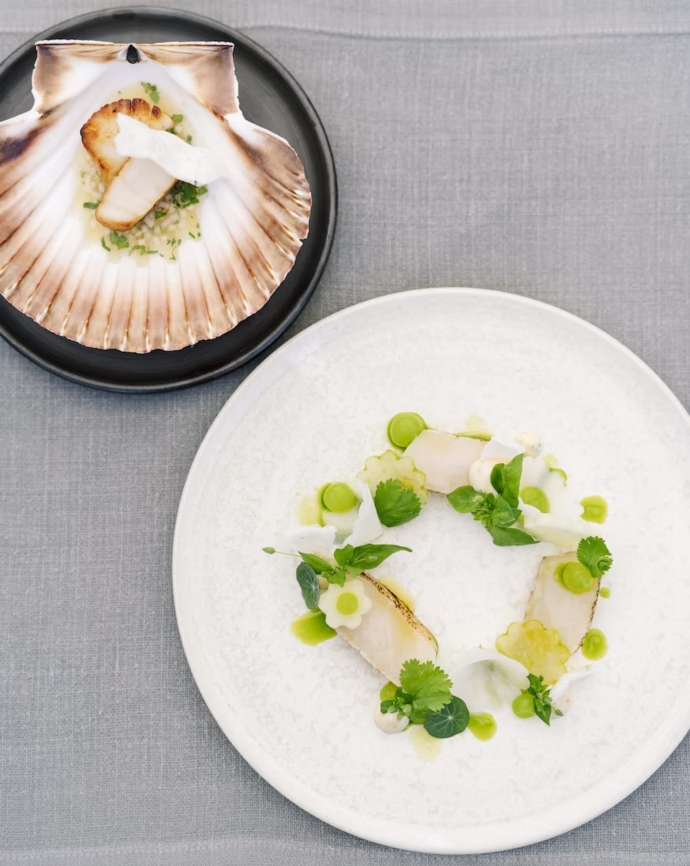

Scallop with turnip cabbage, green apple and coriander from PRISMA; the restaurant's elegant exterior; cool off in the lake at Vitznau; below: the cable railway system that takes passengers up to Bürgenstock / PHOTO: SGV (Lake Lucerne Navigation company)

When people think of Swiss food, they think of fondue and rosti, but there’s so much more
Though the 36-year-old chef Patrick Mahler – who’s lived in central Switzerland for six years – has only been manning the stoves at focus for a year, the restaurant’s double stars are arguably down to his vision. Mahler’s creations, such as Swiss char caviar spooned atop Japanese custard royale and tender veal sweetbreads with local hazelnut, white asparagus and capers continue to garner global acclaim. “When people think of Swiss food, they think of fondue and rosti, but there’s so much more,” he says.
After a few restorative days in Vitznau, I hop on a scenic 30-minute steamship journey across the lake to the shores of Canton Nidwalden, one of many Unesco World Heritage sites on the lake known for prehistoric pile dwellings dating back more than 6,000 years. Vierwaldstättersee is actually a freshwater fjord, which is easy to understand when you’re out on the water gazing up at the mighty snow-capped mountains on either side of you. As the ship chugs leeward, the town of Lucerne disappears from sight.
Disembarking in the tiny village of Kehrsiten, I step into a cherry-red funicular for a four-minute journey up to Bürgenstock (the ferry and the funicular are free for hotel guests). Today, Bürgenstock is home to four separate hotels. It’s a sybaritic riot of grand old hotel parquetry mixed with a dose of mid-century glamour, bestowed on the resort from VIP visitors over the years such as Sean Connery, Jimmy Carter and Henry Kissinger. Former guests Sophia Loren and Audrey Hepburn loved Bürgenstock so much, they both moved there. Hepburn even married her first husband Mel Ferrer in Bürgenstock’s chapel in 1954.
I step into a cherry-red funicular for a four-minute journey up to Bürgenstock
That glamour and mystery still endure today, especially in the spa’s gravity-defying infinity thermal bath perched precariously over a cliff top and whipped by crosswinds. You can check into Bürgenstock’s Waldhotel, a timber-slatted resort-clinic hybrid with views overlooking the rear side of the mountain dotted with weathered Swiss barns, cows and sheep. The hotel’s restaurant Verbena is a highlight of my Bürgenstock stay, and dishes such as pheasant stock, cherrywood-smoked venison and sturgeon with Lucerne caviar are by turns healthy and edifying.
From Waldhotel, an easy 30-minute hike takes me past Hepburn’s and Loren’s villas to Villa Honegg, an old-fashioned boutique hotel with 23 rooms and a creative kitchen sending out dishes such as goat curd with mint pesto; alpine cheese with dandelion honey; and Swiss pike ceviche with fir sprouts and cilantro.
Take a hike: Key walks in the region to check out
The Buiräbähnli (“farmer’s cable car”) Safari in Nidwalden’s Engelberg is an alpine farm trek that utilises farmer’s gondolas and cable cars to visit remote farms where you can sample cheese and alpine butter. The hikes are ideal for families and those with limited mobility, and some skirt the Entlebuch Biosphere, a 395km2 valley that’s home to a Unesco World Heritage site noted for its endemic wildflowers, such as enzian and edelweiss, and rare birds, such as cuckoos, owls and grouse.
One of Uri’s most scenic trails is accessed by a self-operating open-air gondola to the Ober-Axen trailhead. Along the 5km Eggberge trail, you’ll encounter mossy forests, hermetic dairy farmers and wildflower-strewn meadows.
Golzernsee is an easy-to-medium 6km hike over chalet-filled fields. The Golzernseilbahn whisks you over emerald pastures to the Golzernsee trailhead. The trail’s flat first half is an easy hike lined with honour-system huts that are run by farmers’ kids hawking wheels of Alp cheese and locally quarried quartz.
Once you reach Golzernsee, a small green alpine lake perfect for summer swims and picnics, you can spend the day swimming or hike further up to the top of the trail’s second, more difficult stretch.
Serious hikers can plunge even deeper into Nidwalden’s alps by trekking the 24km, five-hour route (or 30-minute drive) to Bannalpsee and Alp Oberfeld, home turf of sustainable alpine cheesemakers Rita and Josef Waser-Späni. “We process 120 litres of organic dairy every day,” says Rita. “We use copper kettles over an open fire and rely on dairy from heritage breeds of livestock such as peacock mountain goats and Rhaetian Grey cattle to produce our cheeses.”
Over the years, I’ve brought multiple visiting friends to Vierwaldstättersee’s sharpest bend, on the opposite shore in Canton Schwyz. If there’s one road that begs to be driven on, the jaw-dropping Axenstrasse, whose northern axis point starts here, is it. The curvaceous passage catapults and corkscrews for over 11 glorious kilometres, plunging through century-old mountain tunnels and dangling precipitously above cliff walls cascading down to azure waters.


Stoosbahn leaving the mountain station Stoos; Villa Honegg, an old-fashioned boutique hotel; a badi (lido) in Vitznau; below: Axenstrasse's picturesque view / PHOTO: Switzerland Tourism (Andre Meier)

Over on the southern edge of Canton Schwyz is the town of Brunnen, home to Strandbad Hopfräben, one of the lake’s many badi (swimming lidos). Before Switzerland developed its north-south axis highways in the ’70s and ’80s, Brunnen was a popular lunch stop for Italy-bound motorists. Before crossing the Gotthard Pass, they would pause along this stretch for a dish called Poulet im Chörbli (chicken in a basket), served at several venues often marked with a cartoon chicken out front. The crispy-skinned half chicken is served in a surprisingly spicy sauce, a rarity in Switzerland.
Over the years, I’ve tried many, but the version at Oschen, a half-timber gasthaus decorated with hand-painted crests which dates back to 1740, is the best. It’s ideally eaten with fresh kopfsalat (butterhead lettuce) and a heap of pommes frites (fries) and washed down with a cold Swiss rosé.
The jaw-dropping Axenstrasse catapults and corkscrews for over 11 glorious kilometres, plunging through century-old mountain tunnels and dangling precipitously above cliff walls cascading down to azure waters
The Axenstrasse ends in the lakeside town of Flüelen, located in the vehemently independent canton of Uri where the southernmost Italian aiming arm of the lake is called Urnersee. The late Anthony Bourdain refused to visit Switzerland because he mistakenly thought it was a country filled with rich skiers donning Swiss watches and eating truffled fondue. But if there’s one place in Switzerland I bet he’d have loved, it would have been Uri, Switzerland’s poorest canton and arguably its most Swiss. It’s populated by fierce working class labourers, tradesmen and self-sufficient dairy farmers who rely on the rugged Alps for sustenance just as their ancestors did millennia ago.
Fittingly, Uri is the birthplace of Switzerland. On 1 August 1291, in a green lakeside meadow called Rütli, three cantons – Uri, Schwyz and Unterwalden (which later split into the two cantons of Obwalden and Nidwalden) swore a uniting oath, forming a loose confederation against the marauding Habsburgs. This rogue gang was referred to by Latin-speaking Romans as Confoederatio Helvetica, a term still used in the abbreviated form CH to denote everything from Swiss currency to the nation’s sports teams.

Uri is also home to Altdorf, the picturesque cantonal capital where William Tell allegedly shot an apple off his son’s head. It’s marked today by colourful murals and statues in the town’s bustling platzli (plaza). His birthplace of Bürglen, just a few kilometres away, is also worth a visit and noted for its charming William Tell chapel.
In 2019, native guide Hansruedi Herger launched his own sustainable small group tour operator called The Alps By Joe. He takes guests to see the lake’s red pine forests and ibex colonies and feels that his native Uri has a special allure. “Urnersee is the most magical part of the lake and its deep green beckons you to plunge in,” he says from his home in Bürglen. “Swimming in this arm of the lake restores harmony in your body, especially after a hike.”
The deeper you go into Uri, the sunnier and more Italian it feels – a reminder that Switzerland’s sole Italian-speaking canton, Ticino, is the next stop heading south, while Italy itself is less than 100km away. Indeed, Uri remains the only canton besides Ticino where learning Italian is still mandatory in primary school. What’s more, Swiss cuisine here begins to mingle with Italian through dishes such as the creamy alplermagronen (a macaroni and cheese dish with roots in Switzerland and northern Italy) and ghackets mit hörnli (macaroni and minced meat ragù).
Tempting as it is to give in to the gravitational pull of Italy and the magnetic Roman world to the south that sculpted so much of Europe, I plant myself here on the lakeshore at the seams of these two distinctly different European cultures. Sunset comes early in Uri and the sun sinks behind the sculptural Urner Alps, electrifying the tips of mountain tops in a spectacularly pink display of alpenglühen or alpenglow.
Swiss as the scene is, it’s the moon rising over sparkling Urnersee that is a moving and fitting finish to any visit. As it peaks over the Alps and shines down on the lake’s glassy surface in a million milky shards, I regard the goodness, the tolerance and the virtue of these Alps, and my sense of the world is restored once again.
Please check the respective locations’ websites for opening hours as well as booking requirements before visiting, and remember to adhere to safe-distancing measures while out and about.
Information on travel advisories is accurate as of press time. For the latest travel advisory updates, please refer to the Ministry of Foreign Affairs’ website.
To learn more about Singapore Airlines flights, visit singaporeair.com.