
While everybody knows a thing or two about white or red wine, most know little about sake. Here are the basics of Japan's national drink
 Often called nihonshu in Japan, sake (pronounced sah-kay) is a quintessential alcoholic fermented rice drink. Though long used for everything from weddings and funerals to company openings, Japan’s national beverage is starting to make waves abroad as well. From Singapore to San Francisco, drink aficionados are waking up to the subtle flavours, tricky classifications and bold pleasures of proudly crafted rice wine.
If you’re a sake newbie, here is a cheat sheet to help you wrap your head around this delicious drink.
1. Polishing
One of the first steps in sake-making is the polishing or milling of rice grains to remove the bran, exposing the starch component at the core of each grain. With increased polishing, more of the proteins, fats and lipids that lead to unwanted flavours and aromas in the brewing process are removed.
Premium sake is usually made with grains that have been polished to about 50%–70%. This means 30%–50% has been polished off. Generally, the more the rice has been polished, the higher the classification level of the sake.

2. Fermentation
Next, sake brewers begin the process of making shubo, a yeast starter or seed mash that is considered the foundation of sake brewing. The rice is washed, steam-cooked and then mixed with yeast and koji (a type of mould known technically as aspergillus oryzae). The small starter batch is then left to ferment to grow a vibrant yeast colony, before it is moved to a larger fermentation tank. More steamed rice, koji, and water are added into the main tank, called a shikomi, for 18 to 32 days, after which it is pressed, filtered and blended. Most sakes are also pasteurised and left to age for at least six months, rounding out the flavour, before being shipped out.
3. Sake classifications
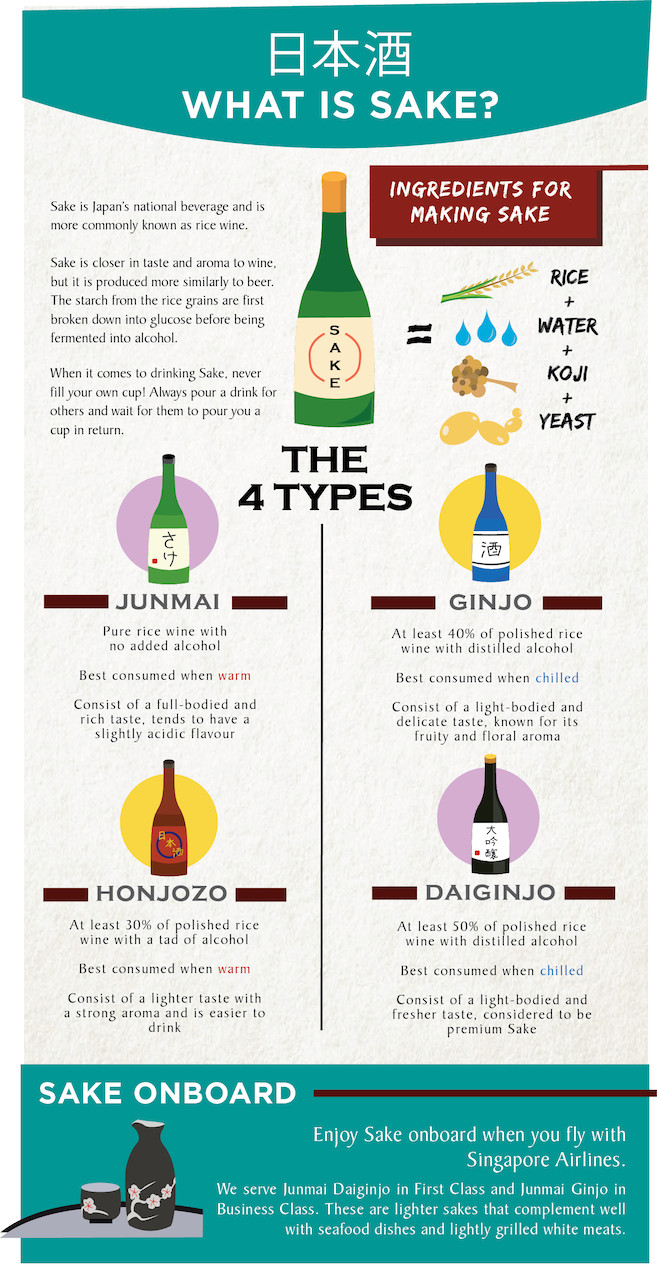
There are so many types of sake and most have an alcohol content of 15%–16% on average. To keep things simple, we’ll stick with four main classifications:
a. Junmai
Junmai is Japanese for “pure rice” and is an important term as it separates pure rice sake from the non-pure version, also known as honjozo (more on that later). The junmai rice is polished to 70%, and brewed using only water, yeast and koji. It is said to have a rich full body with an intense, slightly acidic flavour.
b. Honjozo
Honjozo also uses rice that has been polished to 70%. The difference: it also contains a small amount of distilled brewer’s alcohol, which is added to smoothen out the flavour and aroma. Honjozo sakes are often drier, lower in acidity and less cloying and fragrant than pure sake.

c. Ginjo & Junmai Ginjo
Ginjo consists of rice milled to 60%, water, koji, yeast and added distilled alcohol. It’s usually made in smaller batches to control the fermentation process better. Usually quite fragrant, it has a light, fruity and complex flavour. Junmai ginjo is simply a pure rice sake made with a brewing process involving low-temperature fermentation. No distilled alcohol has been added.
Try: Saito Ginjo Aged (12 years)
d. Daiginjo & Junmai Daiginjo
Daiginjo is a premium version of ginjo sake – “dai” stands for great, or big – that’s made with rice polished all the way down to at least 50% and has added distilled alcohol. It also requires precise brewing methods. Light, fruity and fragrant, daiginjo sakes are often relatively pricey. Considered the highest grade of sake, junmai daiginjo, on the other hand, is daiginjo sake that hasn’t been brewed with distilled alcohol. It is also brewed slowly and at low and precise temperatures.

4. Find your preference
The differences don’t end there. And even with sake, the saying “different strokes for different folks” applies.
Namazake: “Nama” essentially means “raw” or “live” in Japanese, so namazake has not been pasteurised. Namazake has to be refrigerated to stay fresh and has a fruity flavour with a sweet aroma. Majority of sakes are pasteurised twice (once just after brewing and again before shipping) although there’s one type of sake that’s pasteurised once — the namazume.
Nigorizake: This is cloudy white and coarsely filtered so you may find small bits of rice floating around in it. Nigorizake is also usually sweet and creamy with a texture that ranges from silky smooth to thick and chunky, depending on the filtration method.
Sparkling nihonshu: Said to be easier to drink than regular nihonshu, its popularity is bubbling over in Japan. Similar to sparkling wine, it is bottled before the fermentation process has fully ended, resulting in the creation of bubbles.
Koshu: Koshu essentially refers to old or aged sake. Although you can enjoy them well after a year, most sakes are made to be consumed within a year of production. However, it’s been said that, just like vintage wine, sake can transform into a more sophisticated, richer version of itself through ageing, although this is not recommended for namazake sakes.
Jizake: This translates to “locally-brewed sake” and refers to sakes unique to a town or region. In practice, jizake also refers to low-production sakes produced by small (often family) breweries.

5. How to drink your sake
While junmai sakes are best served warm or at room temperature, honjozo sakes are light and easy to drink, and can be enjoyed both warm or chilled. Ginjo and daiginjo sakes are usually served chilled to bring out their complex flavours and aromas.
With premium sakes, many connoisseurs recommend drinking them out of a glass to avoid affecting the complex and often subtle flavours and aromas. But it’s also fun to drink sake the traditional way: out of an ochoko (a ceramic cup) or masu (a square wooden receptacle).
With this quick lesson and a few tastings of the different types at your favourite izakayas, you should be well on your way to becoming a sake expert.

Food pairings
Sake sommeliers will vouch that this truly enigmatic and versatile beverage can complement food just as superbly as wine does. In fact, it pairs with some ingredients, such as asparagus, that can be difficult for wine.
A junmai sake goes down well with a rich flavourful dish, such as stewed meat or fish dishes or cream-based dishes such as gratin. It also goes well with desserts such as crème brûlée or cheese cake. Junmai ginjo goes well with delicate flavours such as sushi and sashimi or steamed fish.
Honjozo is a great match for hiyayakko (cold tofu with onion and soya sauce), tempura or wagyu and vinegar-laced dishes. If Western is on the menu, fish and chips and other fried or grilled dishes are a good pairing.
Ginjo and daiginjo complement light, simple dishes (try to avoid greasy or meaty dishes), including white fish sashimi, ohitashi (boiled greens in bonito-based broth) and mountain vegetable tempura. Daiginjos also go perfectly with fresh fruit.
SEE ALSO: 3 cozy sake bars to visit in Singapore